ISO Standards in the UAE: A Practical Guide
Wiki Article
What Is An Iso Consultant From The UAE Really Do?
The term 'ISO consultant' is used in a broad sense across the UAE market, and companies working towards certification for first time usually aren't sure what they're paying for when they work with one. Understanding the nature of the job helps establish reasonable expectations and allows to determine if a consultant can provide genuine value.Translating the Standard Into Practical Business Terms
ISO requirements are formulated in a formal, generalised language designed to apply across countless industries. As such, a large part of a consultant's job is translating these requirements to what they really mean for a particular company's day-today operations. A great consultant spends in analyzing how an enterprise actually operates before recommending how its existing processes map onto the requirements of the standard.
Assisting with the Initial Gap Assessment
Most engagements begin with a structured gap assessment, which compares current practices against the relevant standard's requirements to pinpoint what already exists, what has to be modified, and the ones that are absent completely. The assessment determines the overall process timeline and budget which is why an in-depth real-time gap assessment is needed more than an optimistic assessment that underestimates the work involved.
Assistance in Building or Refinement of Management System Documentation
Once gaps are identified, consultants typically assist in developing or improve the procedures, policies and records that are required to prove compliance. However, contemporary standards emphasize commitment to process over volume of paperwork. The best consultants will fight against the need for excessive documentation just in the name of convenience, favouring a system the business will actually use over ones designed to simply satisfy an auditor's list.
Training Staff on New or revised processes
Implementation isn't only a management exercise, as staff from all levels need to understand the trends in their day-to-day work and the reasons behind it. Consultants usually conduct training sessions to develop this knowledge, since a management structure that's just on paper, without genuine staff involvement can fall apart quickly after the initial pressure to be certified has been surpassed.
Conducting Internal Audits - Before the Actual Thing
All standards require at most an internal audit prior to the external certification audit takes place The consultants will typically conduct this on their own or train personnel within the company to conduct this. Internal audits serve as an opportunity to test the waters, surfacing issues while there's still the opportunity to address them rather than finding issues for the first time before outside auditors.
The Business Supporting External Audit
Although consultants can't typically be active on the business's behalf during this certification exercise, due to the requirement for independence, good consultants prepare businesses thoroughly before the event and are available to help interpret and rectify any violations the external auditor identifies.
What a Consultant Should Not Be Doing
A properly-run consultant should never be the same company issuing the certificate itself, as this compromises any independence that the entire system relies upon. Any professional who is able to implement your system of management and also issue a certificate under the same umbrella is a real risk to consider rather than being a shortcut.
Helping Interpret Standard Revisions and Updates
ISO standards are continuously revised and a skilled advisor keeps clients informed of future changes long before they become mandatory, allowing businesses the opportunity to adjust rather than scrambling at the last minute. This advisory function often continues well beyond the initial certification process especially for those that employ a consultant on a smaller, ongoing basis to provide surveillance audit assistance.
Adjusting the Methodology to Business Size
A skilled consultant adjusts their approach appropriately depending on whether they're working on a one-person startup or an entire business, as an management strategy that's appropriately proportional to business size and complexity is greater likelihood of being managed successfully than one based off large-scale requirements. Beware of a single-size-fits-all model in use regardless of the enterprise's actual size.
Establishing internal Capability Dependency
The most successful consultants strive to make a client more self-sufficient than they entered it, developing internal employees to eventually manage the system independently instead of creating an ongoing dependency purely for their own ongoing billing. When you inquire directly about a potential consultant how they approach internal capabilities development is an effective way to judge if they're dedicated to long-term customer satisfaction.
A Realistic Timeline for Engaging the services of a consultant
The majority of companies don't know how early in the certification journey the consultant should be engaged, often seeking out consultants only when a deadline has been set and is looming. Engaging a consultant as early as possible in order to conduct a full gap assessment, rather than rush implementation under the pressure of time, consistently produces a stronger managed system, which is more sustainable instead of a time-bound, deadline-driven engagement.
Recognizing When You've Outgrown the need for a consultant
Certain UAE firms, especially larger ones that employ dedicated compliance or quality personnel have reached a point where they can handle ongoing surveillance audits, and even regular transitions entirely in-house. They can also engage consultants only for professional input. Recognizing this change instead of continuing to pay for all assistance from consultants for the duration of time, shows the maturation of management systems that is truly a part of the way in which businesses operate.
Understood properly, a good ISO specialist in UAE is not an administrative vendor and more like a temporary addition to the management team, guiding companies through a significant change in its operations rather than creating documents to meet some external requirement. Choosing the right consultant, in addition to knowing exactly what their role is and should not include, makes the difference between a certification process that actually improves the way the company functions, and one that simply issues a certificate without any lasting changes in operational processes behind it. This does not make the job of a consultant less valuable, but it's a good idea to look at the relationship as one that is a genuine partnership rather than transfer the entire responsibility to another person. This kind of mindset shift alone can lead to produce a considerably more than a lasting and reliable certification result. If you think about it this way, your engagement is a real investment instead of merely a cost of compliance. This is a distinction worth making sure to keep in mind during the course of. Check out the most popular ISO 45001 Certification for website tips.
ISO 9001 Explained: Quality Management for UAE Companies
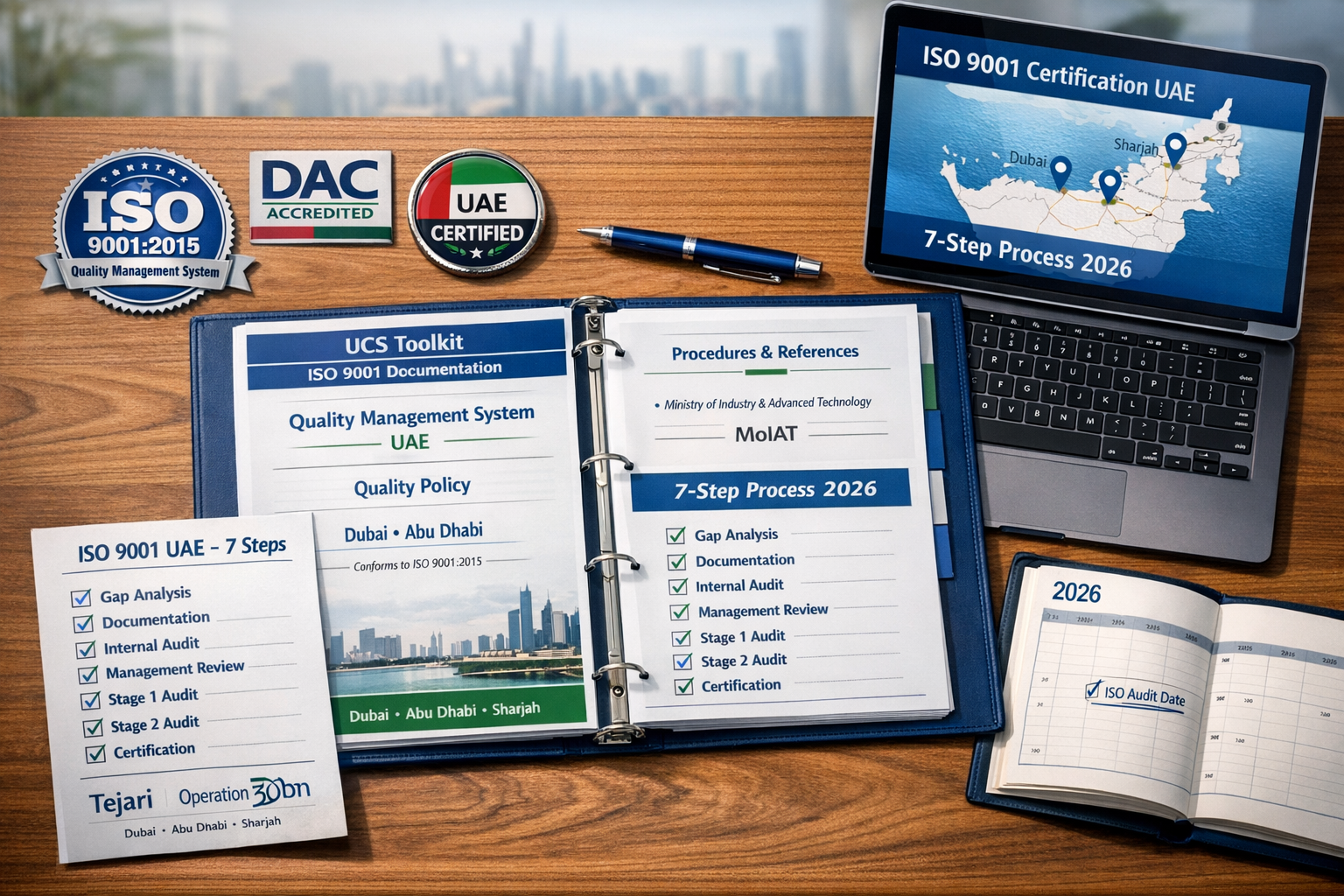
ISO 9001 remains the most well-known management standard across the world, and with good reason: it's based around a pragmatic idea that constant quality comes from consistent, well-managed processes rather than good intentions alone. For UAE companies looking to become certified, understanding what the standard actually requires can help simplify an approach that is often more complex than it actually is.What ISO 9001 Is Actually is Built Around
The premise behind ISO 9001 is that ISO 9001 asks a business to identify its core processes understanding how they interact, monitor whether they're actually working, and then refine them in a systematic manner in time. rather than dictating precisely how an organization should run in a specific way, ISO 9001 offers a framework to ensure that whatever method that a business follows adheres to the same principles, is documented where the need arises, and adhered to.
What is the reason UAE Businesses Want It?
Beyond the reputability of certification, a lot of UAE enterprises are looking to achieve ISO 9001 because government and tenders for private sector companies increasingly include it as a prequalification requirement. Beyond the fact that it is a requirement, businesses that implement it properly often find genuine operational advantages, such as fewer repeat mistakes, better accountability and a more disciplined approach to dealing with customer complaints.
The Role of Top Management
One aspect that the standard is extremely clear on is real leadership involvement, not quality management being delegated entirely to a single compliance official who is unaffected from actual decision-making. Auditors specifically seek evidence that senior leaders understand and actively support the quality management system instead of merely signing off on it.
A Risk-Based Approach is Essential to the Modern Standard
The current Version of ISO 9001 places considerable emphasis in identifying opportunities and risks appropriate to a company's particular situation, instead of applying general guidelines, regardless of the specifics. This means that a UAE construction company as well as a UAE software firm, while both certified against the same standard they will come up with significantly different quality management processes showing their distinct risks.
Customer Focus Runs Throughout the Standard
ISO 9001 repeatedly returns to the idea that quality refers to meeting customer requirements along with expectations. Quality isn't just internal efficiency measures. The companies that implement the standard are expected to establish a solid system to comprehend what customers require and ensuring that they are content, not simply assuming internal quality checks alone capture the entire picture.
This Certification Process Itself
After having implemented the necessary procedures and documentation, certification entails an external inspection that occurs in two phases. First, the auditor reviews documentation and readiness, then looking at whether the system truly operating as stated. The certification process is followed by annual inspections of surveillance and a thorough review of recertification every 3 years to ensure regular conformance.
Common Misconceptions Worth Clearing
It is widely believed that ISO 9001 requires enormous volumes of paperwork, when the current version actually reduced mandatory paperwork significantly when compared with previous versions, focusing more on the demonstration of a genuine process control. Another common misunderstanding is that certification guarantees that the product is of high quality, but in reality it certifies that the company has a uniform method of managing quality, which is a distinct however, still a significant thing.
How Differently It is Applied Across Different Sectors
A construction firm implementing ISO 9001 will focus heavily on the process of handover for projects as well as subcontractor management, while a professional services firm might be focusing heavily on client interaction processes or knowledge-management. This standard's versatility in a variety of sectors is why it remains relevant across a range of UAE industries which range from manufacturing to retail and consulting.
The Importance of Continuous Improvement
ISO 9001 doesn't treat quality as a set destination, however it's a constant process of monitoring performance, identifying opportunities to improve, then implementing those changes efficiently. Businesses that are truly committed to this continuous improvement philosophy, rather than focusing on certification as an event that is only once in a while, are the ones that see the most meaningful long-term operational advantages from the standard.
Be Prepared to handle the Cultural Shift
One of the areas that is often overlooked of ISO 9001 implementation is the necessary cultural shift that must be made, transitioning away from informal, dependent methods of working to more systematic, consistent processes that don't solely rely on the memory of a single individual or judgment. Training staff to adapt to this change as well as explaining the actual advantages instead of treating it only as a compliance activity makes a huge difference in how smoothly execution goes.
Why is it that the Investment tends to be a Success?
Organizations that implement ISO 9001 thoughtfully, rather instead of merely treating it as paper-based exercise that is meant to satisfy an external requirement, often observe that the investment pays off by fewer mistakes, clearer internal accountability, and an extremely solid foundation for scaling operations as the business expands. These benefits extend far beyond the ISO 9001 certificate that it comes with.
When and how ISO 9001 Interacts With Customer Specific Complaints
The requirement is that businesses establish a solid, well-organized procedure for dealing with customer complaints as well as feedback, taking each incident as a factual point that must be fed back into improvements to the process, rather than being resolved and forgotten. UAE businesses that can build this feedback loop well often discover that it is one of the most useful components of the entire management system, well beyond its role to satisfy the audit.
For UAE enterprises who want to know if ISO 9001 is worth pursuing In the end, it all boils down the question of whether the business genuinely wants more consistent, better-managed processes, since the certification is actually a formal confirmation of the underlying operational rigor. For UAE companies who are truly committed to improving their operations rather than just obtaining the certification, ISO 9001 offers a tested, internationally recognized method to make that improvement regular and not accidental. There is no need to change what works within the business, as ISO 9001 is fundamentally about consolidating and establishing good practice instead of replacing it using a new and untested system. In this way, the certification becomes an integral part of good management and not an external burden on the company. It is, in the end an approach based on simple sense, which is applied consistently rather than something that is a mystery. That over all else is the reason it deserves real consideration. Few other investments can offer such an extensive, long-lasting and lasting operational value. Really worth the time and effort it takes to get right. View the top rated ISO Consultant UAE for site recommendations.